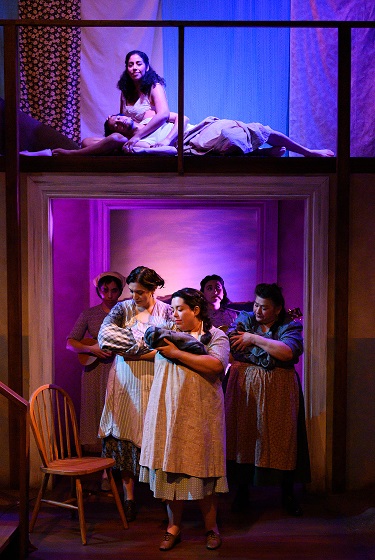
“Yerma,” a play by Federico Garcia Lorca, adapted by Melinda Lopez, opens with a simulated sex act between Yerma and her husband Juan. As directed by Katja Rivera and staged by intimacy choreographer Natalie Greene, the scene, as they say, “leaves little to the imagination.”
It is a courageous and, even today, shocking theatrical maneuver, but it makes sense. Lorca’s play is as earthy as a play can be, diving deep into the mysteries of sex and birth. Not jut mysteries, but, specifically, women’s mysteries, from which men are excluded.
Yerma is a young wife who loves her husband and longs for a child. Juan is a young husband who loves his land and expects his young wife to know her place. All might be more or less well, but their marriage has remained barren for too long, and it seems clear that they will be childless.
While Juan is only mildly disappointed, Yerma is devastated. What meaning does life have, she wonders, for a childless woman? Although Juan encourages her to except her situation, Yermas is haunted by her thwarted dreams. Her private passion leads to an ever more intense estrangement from her husband, who spends more and more nights watching over his crops in the fields.
In today’s world, the idea that a childless woman is unfilled and leads a meaningless life seems, to say the least, old fashioned, if not outright offensive.
But in the magical, primeval, world of Lorca’s women’s power—spiritual and magical—is rooted in fecundity. Yerma understands this and sets out on a quest to discover
her personal power as a woman, while maintaing her honor and dignity as Juan’s wife. It isn’t easy.
Her search leads her to consider an affair with Victor, whom she perhaps has loved all her life, and who could give her the child her husband cannnot. But she resists.
Her search takes her to consult the local bruja, a wily old one, who offers practical wisdom and occult secrets.
Yerma’s pursuit of female empowerment is depicted in a metaphorical and magical way, in performances that move beyond story telling into embodied ritual. Yerma and the women, leading entirely separate spiritual lives from the man, engage in chants and dancing, haunting percussive music, and magical ritual that take us into an other worldly encounter with mystery.
In adapting Lorca’s play, Melinda Lopez and director Katja Rivera have freely incorporated images around the idea of the power of fecundity that include references to Wicca, the ancient goddess Isis, and the Yoruban concept of Ashé from the African religion of Ifá, not to mention an appearance by the Horned God of European pagan lore. All this is to good effect.
In the end, Yerma finds her power, but at a terrible cost.
The drama offers its audience something rare in contemporary theatre, a truly cathartic experience, in the tradition of Greek drama, which, like Lorca’s dramatic vision, has roots in religious ritual and sacrifice.
“Yerma” plays at the Ashby Stage in Berkeley through June 18, 2023. For futher information, click here.
_________________________________
Rating: **** (For an explanation of Theatrestorm’s rating scale, click here.)
_________________________________
“Yerma,” adapted and translated by Melinda Lopez from a play by Federico García Lorca. Director: Katja Rivera. Music Director: Beth Wilmurt. Scenic Designer: Nina Ball. Sound Designer: Sebastian Gutierrez. Lighting Designer: Sara Saavedra. Prop Designer: Vincent Chau. Costume Designer: Valera Coble. Fight Choreographer: Raisa Donato. Intimacy Choreographer: Natalie Greene.
Cast:
Incarnación: Linda Amayo Hassan. Juan: Caleb Cabrera. Veronica/Rosa/Maria: Mylo Cardona. Marta/Chorus: Linda Maria Girón. Yerma: Regina Morones. Victor: Samuel Prince. Dolores: Aisha Aurora Rivera. Maria/Chorus: Alejandra Wahl.
 TheatreStorm