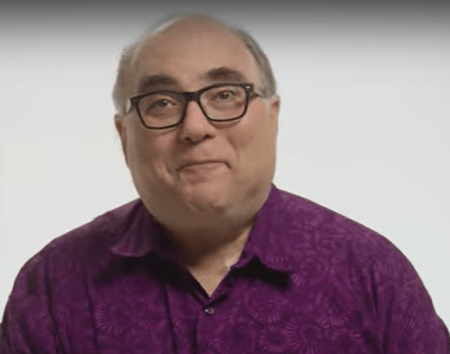

Josh Kornbluth’s one man shows, which he calls “autobiographical monologs,” represent a unique art form. Kornbluth is not really an actor, nor is he a comedian. He is a lecturer, whose subject is himself and his personal experience, and whose presentation tends toward the humorous. He’s like the best college lecturer you ever encountered: astute, intellectual, challenging, questioning. He makes willing students out of his audience. Perhaps the best description I can come up with for his work would be “intellectual entertainment.”
Unlike most lecturers, Kornbluth does not ad lib or go off on riffs. His monologs are polished, precise, designed with a dramatic arc, and thoroughly entertaining.
The life experience that was the impetus for “Citizen Brain,” his current offering, was a year long fellowhsip at the University of California San Franciso’s Global Brain Health Institute.
But Kornbluth doesn’t begin the discussion there. Instead he seems to be off on different tack, discussing his upbringing by parents who were passionate communists, an experience he has previously explored in his his monologues on the subject, “Red Diaper Baby.” But what does this have to do with brain science?
Well, it seems that in her old age, his mother, long single, responded to an ad in a Communist newspaper by an elderly gentleman in faraway Chicago (she resided in New York) seeking a communist woman of similar age for companionship and perhaps love. She responded, and soon she had abandoned New York for a community of senior lefties (definitely the Old Left with the emphasis on Old), and, to the astonisment of her delighted son, fell deeply in love.
And then her lover was stricken with Alzheimers’ dementia.
Which led Kornbluth to the Global Brain Health Instute, where a sympathetic doctor invited him to apply for a fellowship, altough his scentific education was limited at best. It seems that the good folks at UC San Francisco were proceeding on the theory that expertise outside of the sciences might offer interesting results.
The assignment involved a variety of workshops (they called them “didactics” and was to culminate in an original research project related to what had been learned.
Kornbluth deftly combines his multiple themes: politics and the Communist idealism of the Old Left, the challenges of dealing with familial dementia, the madness of Donald Trump, and the whirlwhind of our fractured American political life. Looking at a map of voter preferences in the United States with its splotches of red and blue, he recognizes a similarity to a brain scan of a patient with dementia. In dementia, he learns, some parts of the brain lose the capacity to communicate with others. In the case of Alzheimer’s, it is the brain areas responsibe for memory that cannot communicate.
But, he learned, there are other types of dementia. Frontotemporal dementia results not in loss of memory but loss of empathy. The victims of frontotemporal dementia lose the ability to understand and account for the feelings of others. Kornbluth began to suspect that frontotemporal dementia, loss of empathy, might be a model for understanding the apparent dementia of American political life, where empathy seems to have gone the way of the dinosaurs and the dodo.
Eventually in a burst of connecting synapses he found his research program: Would it be possible to develop practices to restore empthy in victims of frontotemporal dementia using similar techniques used to help restore memory in those with Alzheimer’s dementia? And just as memory exercises can benefit even those without a diagnosis of dementia, could empathy exericses benefit those whose empathy skills are low, as if they had frontemporal dementia. In other words: could our currently demented political discourse be improved with treatment and what would that treatment look like?
This may all sound intellectual and perhaps somewhat dull and didactic, but don’t underestimate the comedic joys of Kornbluth’s skillful delivery. He makes these abstract considerations as personal as possible, connects them to our everyday lives, and makes us laugh at our desperate condition. He makes us feel empathy.
Through it all he weaves the biographical story of his father-in-law’s history as a union organizer, his mother’s passion for justice, his own efforts to make peace with the unthinkable, and astute political and social insight.
If you like to think and laugh at the same time, Kornbluth should be your jam.
And what of his research with the Brain Health Institute? Kornbloth has developed a project connecting brain science with social justice: “Citizen Brain.” In collaboration with his scientific colleagues at UCSF, the projecdt consists of a series of videos exploring “the empahty circuit” with a focus on brain science, a passion for a better world, and, of course, humor.
“Citizen Brain,” the performance, is a wonderful, funny, valuable introduction to this important work.
Check it out. Your brain will thank you, and you might find yourelf joining a movement.
“Citizen Brain” continues at Club Fugazzi through 01-14-2024. For further information, click here.
_____________________________
Rating: ***
(For an explanation of TheatreStorm’s rating scale, click here.)
_____________________________
“Citizen Brain,” an autobiographic monlologue written and performed by Josh Kornbluth. Director: Casey Stengl. Dramaturg: Aaron Loeb.
 TheatreStorm