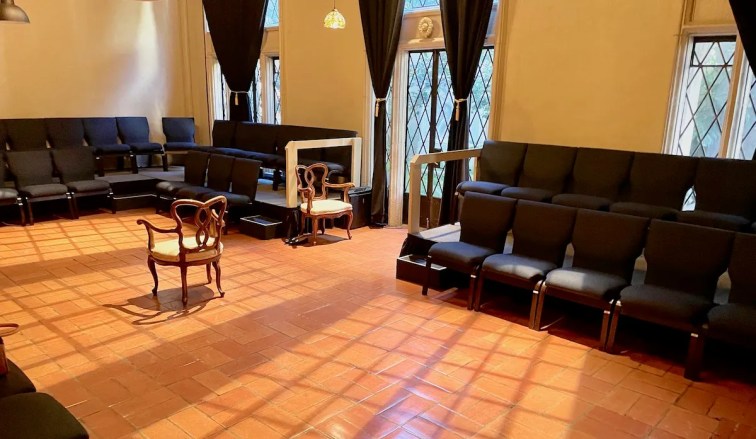

One of the most famous and appealing structures in the City of Berkeley is the Berkeley City Club on Durand Avenue. It was designed by the great Julia Morgan, who was the first woman architect to graduate from the École des Beaux-Arts in Paris. Her career spanned the first half of the 20th century. Morgan designed many East Bay buildings including the Chapel of the Chimes in Oakland and the Julia Morgan Theater (originally designed as St. John’s Presbyterian church) on College Avenue in Berkeley. She is best known for designing and supervising the construction of the Hearst Castle in central California, the inspiration of Charlie (Citizen) Kane’s palace called Xanadu in Orson Welles’ “Citizen Kane.”
The Berkeley City Club (originally the Berkeley Women’s Club) is less well known, but Morgan put her heart into this gem, calling it her “little castle.” She designed it simultaneously with the Hearst Castle, utilizing many of the materials that Hearst brought over from Europe, and hiring many of the same craftspeople for both projects. She also used the “little castle” as a testing ground for some of the ideas that were developed in a grander style at the Hearst Castle.
The Berkeley City Club feels like a miniature medieval cloister. Although very elegant and impressive, its size makes it remarkably welcoming. An art historian might note that it combines Romanesque and Moorish styles found in the Mediterranean. I think of it as medieval, and it reminds me of a smaller version of “The Cloisters” museum in New York City.
The Berkeley City Club has long been an East Bay cultural force sponsoring many lectures, book clubs, music performances, reading series, and dance events. One of its most enduring and significant contributions has been the dedication of one of the high-ceilinged parlors to theatre performances. A rectangular room with no stage, it has been lined with three graded rows of chairs along three of its four walls. The audience sits in those chairs and the actors perform in the center of the room. The audiences are limited to approximately 50 souls. The arrangement is about as intimate as live theatre can ever be.
The first professional theatre company to perform in this remarkable space was the Aurora, founded by Barbara Oliver, who was a member of the club. Later, it was home to the Shotgun Players before they moved to the Ashby Stage. And now it is the home of Central Works, an exceptional theatre company known for producing new plays exclusively.
Central Works did not begin as a “new play theatre” but as a theatre run by and for actors, first and foremost. The founder, Soren Oliver, envisioned it as an actors’ collective. The current co-director, Gary Graves, notes that at that time, in the early 90s, “[Central Works] was part of a renaissance of actor-driven companies including Berkeley Rep, the Aurora, (which only recently closed its doors), and Cal Shakes.” It is interesting to note that Soren Oliver is the son of Barbara Oliver, who founded Aurora.
Recently I sat down with Gary and resident playwright Patricia Milton to discuss some of the history and aesthetic of Central Works. (Gary’s co-director, Jan Zvaifler could not join us as she was in rehearsal for the company’s latest production, “After Happy.”)
In the 1990s, Gary explains, he was a doctoral student in the theatre program at UC Berkeley, specializing in directing. He was asked to write a program note for a Central Works production and that was his introduction to the company. He remembers:
“About that time, devised theatre—plays created collectively by a company of actors along with the playwright—was very much in style. And I thought Central Works should experiment with that. After that we decided to do new plays exclusively. We developed the ‘Central Works Method,’ which involved a group of actors and a playwright starting with no script at all and developing it together from scratch. Since then, about 20% of our plays have been ‘Central Works Method’ plays. The others are more traditional in that the script is fully drafted before rehearsals begin. About 10 years ago we founded the ‘Central Works Writers Workshop’ as a more traditional incubator for new plays.”
In time, Gary replaced Soren Oliver as co-director of the company, holding the reins along with founding actress Jan Zvaifler. In the early years, the company performed in church basements, a pizza parlor, and tiny rental houses in San Francisco. When the Aurora decided to decamp from the Berkeley City Club, Central Works took over the parlor in 2002.
As of today, Central Works has produced 79 world premieres! This is an astonishing accomplishment, to say the least. A few of the new plays were found by the usual method. The producers keep their eyes out for new work, or receive an unsolicited submission, and decide to put it on. But for Central Works, the development of new plays is likely to be much more complex and involve greater company involvement from their inception.
Of 79 world premieres, 20 were developed as collaboratively devised pieces between playwright and actors, using the “Central Works Method.”
That method, says Gary, is “an approach to formulating plays in a workshop with an ensemble of actors, and then a playwright would write a script based on that workshop.” Over the years, Central Works has continued to refine this approach to creating new work. Of the 79 world premieres that Central Works has produced, about a quarter have been created by the “Central Works Method.”
Another source for new plays has been an invitational biannual 12-week playwriting workshop in which a group of writers are invited to support one another in developing new plays, many of which are eventually produced at Central Works. This “invitational” approach—in which workshop participants pay no tuition—has a distinguished history in American theatre practice as it is reminiscent of the famous New York “Actor’s Studio” which, for an incredible 86 years, has provided a workshop environment for actors who are invited (via an audition process) to participate without charge.
This emphasis on new plays places Central Works among a small collection of theatres in America that share that commitment. In San Francisco, only the Magic Theatre (200 world premieres since 1967) has a comparable history of producing new works.
More recently, Central Works has added another wrinkle to their new play development, reminiscent of the Magic Theatre. Central Works has now incorporated the role of “playwright-in-residence,” currently filled by Patricia Milton.
Patricia has participated in several of the playwriting workshops sponsored by Central Works, and has this to say: “The thing that I so prize about the workshop is that Gary’s facilitation is fantastic. It really makes a huge difference. I’ve been in many, many playwriting workshops and it just makes a huge difference who is facilitating the comments on your work. [At Central Works] I get a huge feeling of respect and helpfulness from everybody. It’s amazing.”
When Gary first invited Patricia to create a collaborative work using the “Central Works Method” she thought, “Am I really going to do this? . . . I really have to think about it.” She decided to say yes. The result was her play “Reduction In Force,” a satire of Savings and Loans companies where she had worked as a day job. She felt she knew a lot about the financial meltdown that was occurring at the time.
Since 2011 Central Works has produced nearly a dozen of Patricia’s plays including the award winning (SFBATCC Best Production 2019) “The Victorian Ladies Detective Collective” starring Central Works co-director Jan Zvaifler.
“Being a resident playwright,” says Jan, “having a theatrical home, is just a luxury. It’s a very precious thing for a playwright. It’s just such a lovely experience to have a place where people kind of get you and support you and want to do your work. And I have Jan Zvaifler, a wonderful actor, that I can write for.”
Gary applauds the Central Works audience and subscribers who appreciate new work. “They know that new work is our value, and they are buying a subscription of plays they have never heard of. They’re coming to us because they’ve been before, and they think that we do good work. So they come to see. They’re not coming to see David Mamet or William Shakespeare done while actors stand on their heads, or whatever. They’re coming because they like what WE do.”
Central Works is currently presenting Pam Benjamin’s newest play, “After Happy,” for which they have received a “Go See!!!” designation from the San Francisco Theatre Critics Circle. It plays through March 29 (it closes weekend). For tickets or further information, click here.
 TheatreStorm