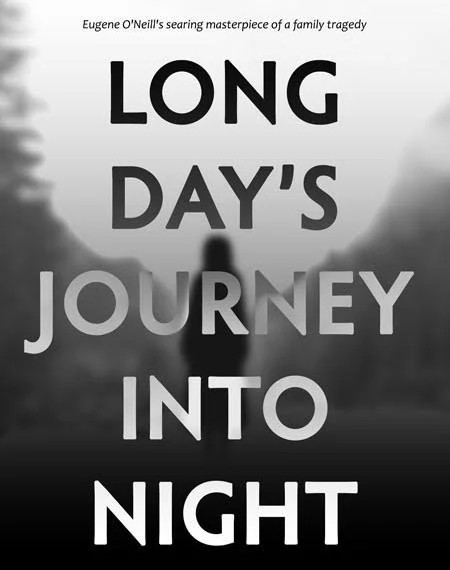
Every committed theatre artist, reviewers included, knows that certain challenges eventually arrive. Directors and actors may have to face knotty problems of interpretation for “Hamlet,” “Othello,” or “King Lear.” Actors might face those roles as well as guilt-ridden Lady Macbeth, or wronged Malvolio. And that’s just Shakespeare. Designers may be faced with staging a play in Antarctica or on Mars.
For a serious reviewer, “Long Day’s Journey Into Night” is such a challenge.
Eugene O’Neill’s great autobiographical family drama is not entertaining in the ordinary sense. It has little plot, almost no relief, and no satisfying resolution of conflict or conventional character growth. The Tyrones appear to move through their summer home like ghosts whose lives have ended. They are merely drifting into the night. It is one of the bleakest canonical plays, rivaled perhaps only by Ibsen’s “Ghosts” for unrelenting pessimism.
O’Neill knew he had written his masterpiece, substantially based in truths about his own family. But he did not expect it would ever be staged. Who would want to watch it? His will stipulated that he did not wish to authorize publication until twenty-five years after his death. Of course, given his exalted position in American theatre, that wish was quickly set aside after his demise, and the play was produced on Broadway only a few years later.
Was he right? Is “Long Day’s Journey Into Night” best experienced in the quiet of a library? Is it truly stageworthy? The verdict of history is that it is indeed, but challenging to get right.
The difficulty is that nothing happens to the Tyrones in the ordinary sense. They are living shadow lives, surrounded by fog and the mournful call of the foghorn. They appear doomed to sorrow. So why would we want to watch?
The wonder of it is that, for all the misery, the Tyrones remain unmistakably alive. They start the long day with hope in the face of overwhelming despair; they love and even admire one another with unmistakable intensity; they keep returning to the old family patterns that both bind them together and tear them apart. And they do so with humor and insight and compassion and art. We do not want to look away.
This astonishing vitality in each of the Tyrones, even in a death grip of sorrow, is what keeps the audience engaged and moved and awestruck. To communicate that is the challenge faced by every production. Can the stage wallow in misery to the extent required, yet still convey love and hope?
In my opinion as a reviewer, this is the hinge upon which every production of this bear of a play must turn.
As with any play, perfect success is elusive, but the essential question is whether a production holds our interest and moves us emotionally. To the extent that a production succeeds in celebrating the depth of the family’s love for one another, and their passion for life in spite of insurmountable sorrows, it will succeed. This holds true even if the play’s full potential remains unrealized. As is often remarked of “Hamlet,” the material is so rich that even a partial success, achieved through sincere effort, can make for a fascinating night at the theatre.
Which brings me to the current ambitious production at the Phoenix Theatre, produced by Kevin Copps, an experienced actor who has played James Tyrone before and was determined, admirably, to have another crack at him.
Directed with a high degree of clarity by Jeffrey Hoffman, and performed with adequate skill by four capable actors, the result is well worth attending.
Copps manages James Tyrone very well. We can see his intelligence, his determination, his pleasure in words, and his concern for his sons. We also see the bitterness at his failure to achieve greatness as an actor, and his passionate love for his wife, Mary. James Tyrone is considered a marathon role for an actor, and Copps makes it to the finish line with dignity. Where he may fall short is in displaying what should be James’s still burning passion for life. James still loves the theatre, in spite of the compromise of his matinee-idol career. He enjoys being a homeowner and puttering around his house, even if his tight fist keeps it in poor repair. He relishes Shakespeare. He loves his sons. And above all, he has not forgotten his adoration for his wife, and in the morning of the play’s long journey he is full of joy at her apparent sobriety after returning from a stay at an asylum. There is, in spite of all, a brilliant lightness to James Tyrone that makes him lovable to his wife, his sons, his public, and even his neighbors, and stands in contrast to the truth of his miserly nature and failure to provide the happy home that his wife and sons so desperately need. Copps’s performance is capable and touching, but falls short of fully capturing the character’s still burning inner light.
As the morphine-addicted Mary, Angela Dant is heartbreaking, as she must be. In the morning of the long day, Mary is the only family member who knows the truth: after only a brief period of abstinence, she has already failed in her struggle to maintain her sobriety. She knows she will have left reality behind once evening comes. And yet, for a few brief moments, she is herself. Dant does well at capturing Mary’s ambivalence, her desire to be sober and present for her husband and sons, yet her inability to face the reality of her losses: her husband James’s bitter regrets, her son Jamie’s advanced alcoholism, and Edmund’s ill health. “Long Day’s Journey Into Night” is mostly Mary’s burden, and Dant’s performance captures the sweetness and the sorrow.
As Edmund, Miles Millikan hits the beats. He is convincingly engaged with his sibling Jamie, his father James, and his mother Mary. Millikan knows what he is about, but does not entirely plumb the depths of Edmund’s profound and sympathetic love for his family. He has the words and performs them with intelligent insight, but his inner life is a string quartet in a role that demands a monumental symphony. The music is there, but muted. As Jamie Tyrone, Peter Malmquist gets all the points across and builds convincing rapport with Millikan’s Edmund, but his passion seems muted.
A fifth character, the household maid to whom, in O’Neill’s script, Mary addresses her long closing monologue, is absent. This is a puzzling decision unless the explanation is the lack of an available actress. I believe it is an unfortunate omission, because when Mary addresses her monologue as she tells her story to another person, she is reaching out for human contact even as she drifts off on her long journey. The maid’s absence changes something in Mary’s character, which may not be consistent with the playwright’s intent.
In summary, this production of “Long Day’s Journey Into Night’ is thoroughly competent, but falls short of the play’s potential. Fans of the play will nevertheless be pleased with this professional work, and those who know it only on the page may well be happy to see it on the boards.
It seems we’ll have to wait a bit longer for a Bay Area production to come along and hit all the notes.
_________________________________
Rating: *** (For an explanation of TheatreStorm’s rating system, click here.)
_________________________________
“Long Day’s Journey Into Night” by Eugene O’Neill. Produced by Kevin Copps/Into Night Productions. Lighting Designer: Asheley Munday. Sound Designer: Enrico Banson. Costume Design: Rachel Aquillina. Fight Choreography: Kristen Matia.
CAST:
James Tyrone: Kevin Copps. Mary Cavan Tyrone: Angela Dant. James Tyrone, Jr. (Jamie): Peter Malmquist. Edmund Tyrone: Miles Millikan.

