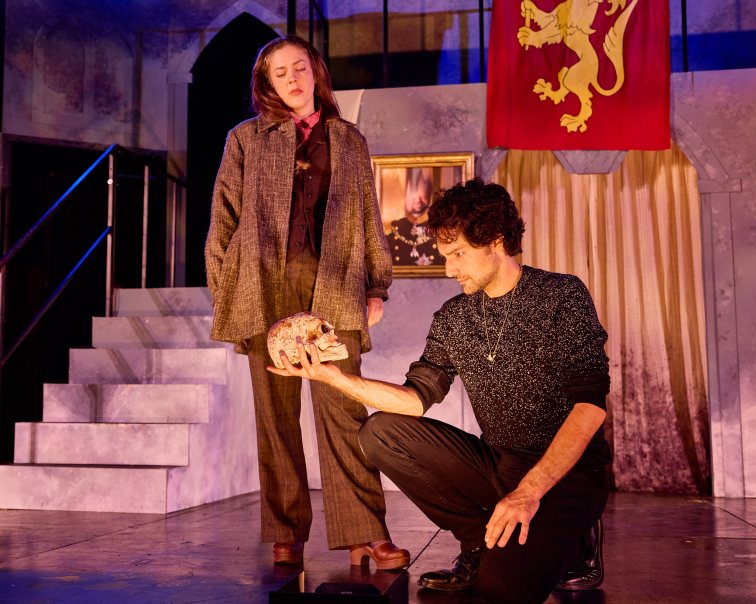

There are many ways to approach “Hamlet.” Because it is so well-known, most contemporary directors will try to find something unusual in their approach. This was true even in 1899 when superstar Sarah Bernhardt successfully took on the role when she was 55 years old. She argued this casting was appropriate because she felt that Hamlet’s self-doubts and hesitation to act violently were expressions of a rather feminine soul. And she had no truck with ageism. There is a long history of “Hamlet” variations that is well justified by the complexity of the play and the part.
I’ve never objected to a production of “Hamlet” that offers something new. I’ve been impressed by teenaged Hamlets. I’ve been impressed by multiple actors playing Hamlet in unison. I’ve been impressed by a version where the entire cast was past the age of 50. I was impressed by Mark Jackson’s “Hamlet Roulette,” staged a few years ago by Shotgun Players, for which the entire company learned every part and drew character cards from a skull-shaped bowl to see who played what for any given performance. I have always been inclined to give innovations a fair hearing and to go along for the ride whenever directors take Shakespeare off the beaten path. I am a cheerleader for exciting experiments. Rah! Rah! Sis Boom Bah!
There is, however, an equally desirable alternative approach. A director can choose to tell the story simply, directly, and without embellishment. That may actually be a very risky choice because novelty, while certainly no defect, can cover up a multitude of sins. If a traditional approach is not done remarkably well, its familiarity is likely to breed contempt and its ugly twin, boredom.
Novel approaches illuminate the play through reinterpretation and new conceptual frames; successful traditional productions turn the trick through exceptional execution. The play’s the thing. But it’s not always the same thing.
With the present production, Director Lisa Tromovitch goes for classic simplicity. The result is remarkable for its insight and precision. This is not a revisionist Hamlet. This is a straightforward “Hamlet” that requires no gilding of the lily. It is riveting in spite of its ringing familiarity, and it achieves a true catharsis.
Watching this show, you won’t just understand Shakespeare’s words. You’ll cry for Hamlet and our sorrowful world.
The performances are excllent. Andre Amarotico is a fine Hamlet, athletic, mercurial, beautifully spoken. This is Amararotico’s second crack at this role. He first played it a decade ago. He brings maturity and confidence to his interpretation. Rob Seitelman plays Claudius effectively as a weak sensualist with a taste for power and a streak of cruelty. He also voices the Ghost with full Shakespearean abandon to the language. Queen Gertrude, portrayed by Lauren Dunegan, is convincingly kind and confused and deeply sad. These are straightforward interpretations, performed with integrity and a high degree of skill.
All of the cast, including Polonius (Greg Parker) and his chilren, Laertes (Nic Moore) and Ophelia (Fortinbras). These three each perform several characters extremely well. Greg Parker displays great versatility playhing not opnly Polonius, but the Player Kingf, the Gravedigger, and the soldier, Marcellus. His Marcellus is particulary well rounded for such a small part. This is a good example of the care for detail that is a hallmark of this production. I should also mention Sarah Dunnavant as Horatia, whose clarity and emotional directness go a long way to bring the audience into the action.
Also remarkable is Charlie Lavaroni, who plays not only Guildernstern, but the Player Queen, the soldier Barnardo, and the foppish courtier, Osric. As Barnardo he speaks almost not at all, but his attentive reactions to everything that occurs about him guides the audience to a clear understanding of the action. He repeats this feat as Osiric, in the opening court scene, again saying nothing but reacting with such excellent mummery that the implications of the lines become crystal clear. Again, attention to details raises the work from well-crafted to fine artistry,
And of course I should mention
I could go on, but, really, the bottom line is that this is a Hamlet worth a special effort to make your way into the vinyards of Livermore.
Rereading this review, it seems I have had little to say by way of criticism. I could nit pick, I suppose, but why bother? Finding flaws in this production is looking for a needle in a haystack.
This show closes on July 26, thsi very weekend. If you have other plans, consider making an adjustment to see this “Hamlet.” You won’t regret it.
“Hamlet” runs through July 26 at Darcie Kent Vineyards in Livermore. For further information click here.
________________________________
Rating: *** (For an explanation of TheatreStorm’s rating system, click here.)
_________________________________
“Hamlet” by William Shakespeare. Produced by SPARC (Shakespeare & Performing Arts Regional Company). Director: Lisa Tromovitch: Scenic Designer: Camryn Lang. Costume Designer: Callie Floor. Lighting Designer: Evan Lopes. Sound Designer: Grant Hubberty. Puppet Designer: Karen Riley. Fight Choreographer: Nic Moore.
Cast:
Hamlet: Andre Amarotico. Ghost (Puppeteers): Anjoli, Aguilar Lauren Dunagan, Sarah Dunnavant, Nic Moore. Ghost (Voice): Rob Seitelman. King Claudius: Rob Seitelman. Queen Gertrude: Lauren Dunnegan. Polonius/Player King/Gravedigger/Marcellus: Greg Parker. Laertes/Rosencrantz/Lucianus: Nic Moore. Orphelia/Fortinbras: Anjoli Aguilar. Horatia/First Player: Sarah Dunnavant. Guildernstern/Player Queen/Barnardo/Osric: Charlie Lavaroni. Players/Servants: Aiden Haines, Karina Sapkota.

