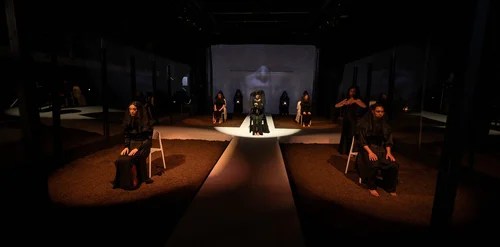
“The House of Bernarda Alba,” Federico García Lorca’s final play, is a stunning tragedy of oppression. Fiercely controlling matriarch Bernarda Alba has been widowed, and left with the care of five daughters upon whom she insists on exercising total control. They are not permitted to leave the house. They must remain in mourning for months, even years, on end, until they find respectable husbands. Every social nicety must be observed. Maintaining class dignity is all important. The play is a very effective indictment of the oppressiveness of social convention, misogyny, coercion, and religious mania.
The first thing to note about this production, directed by Michael Socrates Moran, is its visual impact. Set designer Sam Fehr has built a plexiglass prison of a house, a huge box into which the audience peers. The sense that we are seeing something incredibly private is overwhelming. We are literally peering in through the walls.
The house is divided into rooms with dirt floors which look like freshly dug graves, each room clearly in the shape of a coffin. The mourning family wears black. Every conversation is a wail. Every movement is strained as if through water. The daughters repeat various striking dance moves that evoke the sensation that they are bound and perhaps even tortured.
Outside this house of sorrow and misery, a young man, Pepe, circles the entire structure continuously in a sensuous dance. He is bound to the young women inside by powerful cords of lust. He is engaged to marry the eldest who is a desirable bride by virtue of a large inheritance, even though relatively less attractive than her sisters. No matter. Pepe is also having an affair with one of the younger, more beautiful daughters. The affair must be kept secret of course. If Bernarda Alba finds out, there will be hell to pay. In her madness, she might be capable of anything. As Pepe, the strikingly beautiful dancer Jaden Ramsey communicates enormous emotional depth and sensuality. His presence is riveting.
Reviews for this production have been enthusiastic, mostly stressing its quite remarkable visual beauty and emotional depth. I agree.
Nevertheless, I’m afraid I found “The House of Bernarda Alba” not quite satisfying. The problem, for me, was that once the visual impact of the extraordinary set and costumes has been absorbed, and the repetitive, sometimes symbolic, movement language of the women has been understood, there is very little play here. Every movement is stylized, every line spoken in anguish in a sort of wail, screeched at high volume. For me, the lack of intimate, less anguished interactions between the women makes it hard for me to experience a deep response. By the time the tragic ending arrived, I was too exhausted to experience catharsis.
Certainly, the staging fascinates. Certainly, there is a lot to think about here. Certainly, there is some fine art being presented.
But I longed for some gentler moments to provide contrast. I felt I had absorbed most of the impact of this stylized presentation in the first twenty minutes of performance, but it continued, with little variation, for an hour and a half. I felt kind of beat up, to be perfectly honest.
I will say that this production is magnificently ambitious, with extraordinary beauties, but it does not quite come together into a satisfying whole.
Still, audiences who have the patience for such complex symbolism, intellectual weight, surprising visuals, and a slow, repetitive pace may be thrilled. Certainly, among Bay Area critics who have reviewed this production, enthusiasm has been considerable. My misgivings are my own.
I can only urge the curious to see for themselves.
Whatever its flaws, “The House of Bernarda Alba” is exceptional theatre in many ways.
“The House of Bernarda Alba” runs through June 7, 2026. Note that the venue for this production is the Omni Commons in Berkeley, not the usual Flax Art location for Oakland Theater Project. For further information click here.
Rating: *** (For an explanation of TheatreStorm’s rating system, click here.)
“The House of Bernarda Alba” by Federico García Lorca. Adapted by Chay Yew. Director: Michael Socrates Moran. Set Designer: Sam Fehr. Props Designer: Heidi Button. Costume Designer: Isadora Duskin Feinberg. Sound Designer: Michael Kelly. Projection Designer: Sarah Phykitt. Music Director/Vocal Composer: Bekka Fink. Choreographer: Renee Valentina. Fight Choreographer: Dave Maier.
Cast:
Bernarda Alba: Lisa Ramirez. Maria Josefa/Chorus: Angelina Fiordellisi. Amelia: Natalie Pasquinelli. Martirio: Essa Vilanue. Adela: Antonella Scogna. Poncia: Jacinta Kaumbulu. Prudencia/Chorus: Bekka Fink. Blanca: Shabnam Ayuby. Agustias: Sarah Jiang. Magdalena: Sarah Kasuga. Beggar/Chorus: Eiko Moon-Yamamoto. Beggar’s Child/Chorus: Alula Dreicer. Pepe: Jaden Ramsey. Chorus: Lynwood P Boon.

